
Let’s set the record straight: we did not, technically, inherit any bees with this property. There was no mysterious hive in the lilacs. The bees are here because Kappie and Joe — for reasons they cannot fully reconstruct — signed up for a beekeeping class.
The class was supposed to be a one-Saturday thing. A sampler. A “we’ll know if we’re interested” moment. Instead it became a six-week thing, then a hive thing, then a “we should probably paint this hive” thing, then a “Dorothy the duck is suspicious of us” thing.
Why bees, anyway.
A working farm needs pollinators, and a regenerative farm needs them more than most. We could have planted only for wild pollinators — and we are, in patches — but having our own hive means we know the bees, we know the queen, and we know exactly which fields they visit. (Spoiler: the clover. Approximately all of the clover.)
The class.
Our teacher was a retired beekeeper from two towns over who showed up to every session in the same clean canvas jacket and said the same calm sentence at the start of every class: “Bees don’t need you. You need them to be okay with you.” He has been keeping bees for forty years. He has not, in our presence, ever put on a veil.
Bees don’t need a beekeeper. A beekeeper needs the bees to be okay with them.— our mentor, calmly, while not wearing a veil
What the bees have taught Kappie so far.
Slow down. Bees do not respond well to a fast, stressed human. They respond well to a slow, boring human. Kappie is now striving to be a slow, boring human in their immediate vicinity. (Joe says she should keep this going at home too. She is ignoring Joe.)
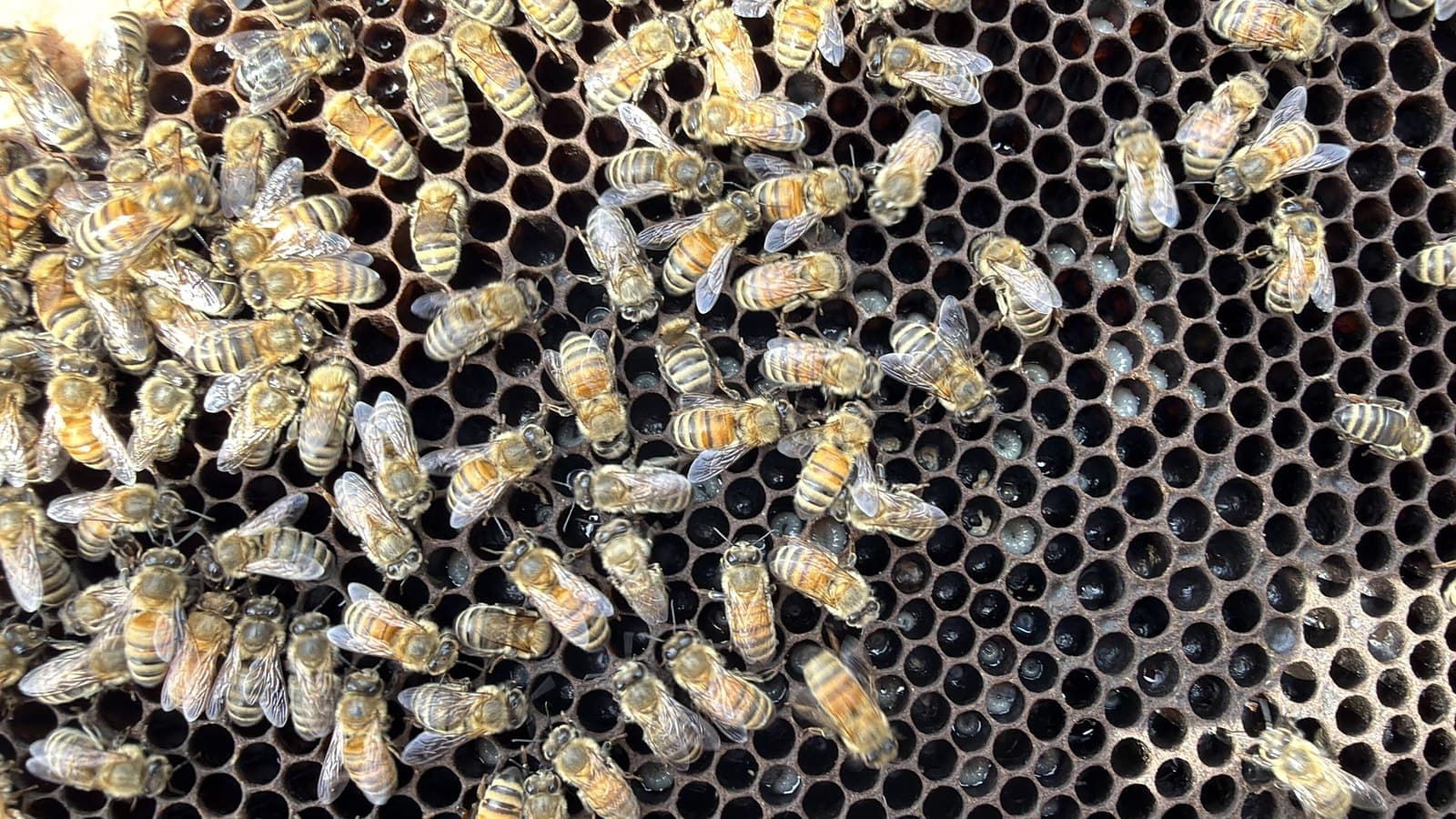
Watch the entrance. Ten minutes of just sitting and watching the front of the hive tells you basically everything about how they’re doing. Are they coming in heavy with pollen? Are they fighting? Is there a weird smell? You can learn a shocking amount without ever opening the box.
Plant for them. We let large patches of the lower field go wild this spring instead of mowing. Clover, dandelions, all the things our suburban lives told us were “bad lawn.” The bees seem thrilled. The goats also seem thrilled, which is a different problem.
The hive.
The hive itself got a paint job, because of course it did. There is now a small painted bee on the front, a sun, and the words BEE COOL. Don’t ask Kappie. She just signed the work order. The work order in this case was a small, enthusiastic human with strong opinions about color and very little patience for primer.
Long live the Queen.
We don’t name the worker bees — there are tens of thousands of them and frankly they are difficult to tell apart even in person — but we do speak of the queen with a certain reverence. She is, technically, doing all the work that matters. We just call her The Queen. She seems fine with this.
The honey question.
People keep asking us if we’re going to sell the honey. Eventually, maybe. This year we’re not taking any. The hive is still figuring out who we are. We’re still figuring out who we are. Everyone needs a soft launch.
✎ — Kappie, slowly and boringly, from the lilacs