
The forecasts were saying record rainfall. The neighbors were saying record rainfall. We were saying things like, “I’m sure it won’t be that bad,” and, “We have boots.” The forecasts and the neighbors were right.
The number.
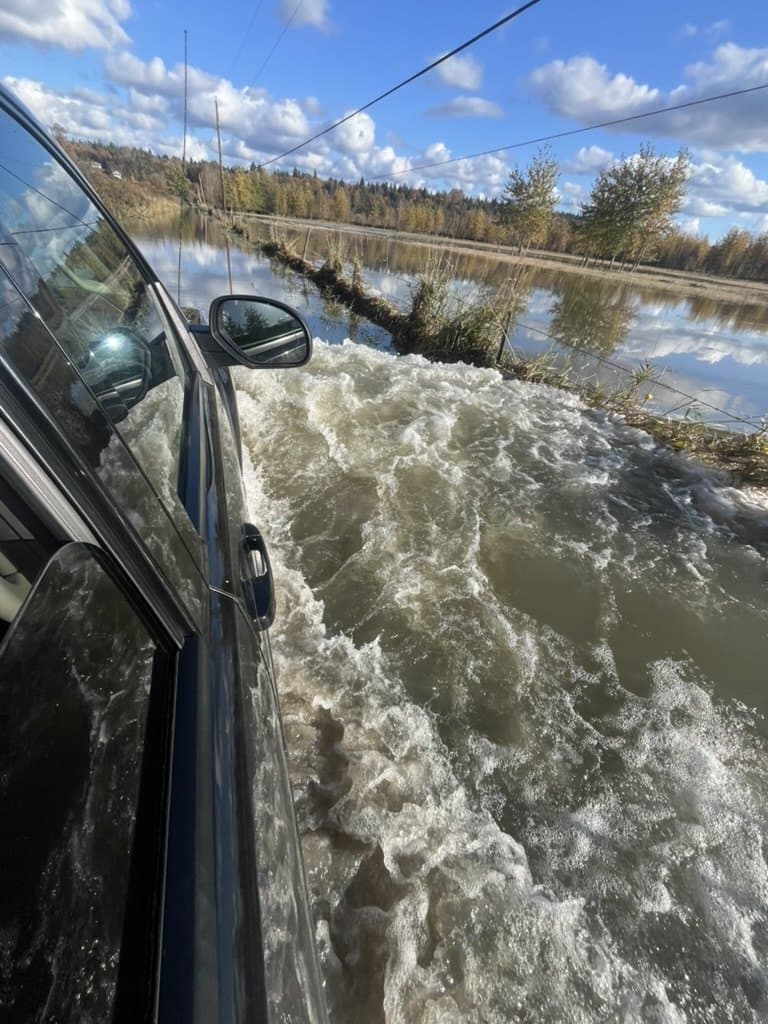
What hit this part of the valley in December 2025 and again in January 2026 is what the people who track these things call a 100-year flood event — meaning, in a given year, there’s roughly a one-percent chance of it. We got it twice, two months apart. Our driveway disappeared under about twelve feet of moving water. The road past the front gate became a slow brown river. For days at a time, the only way to get to the farm was by kayak.
We had, until then, only used the word “kayaking farmers” as a joke about ourselves. We are no longer joking.
What it looked like.
Looking out from the front of the house was like looking out from a houseboat. The lower pasture was a brown, fast-moving lake. The line of trees we always thought of as the property’s far edge became a partial submarine. The water came up to the bottom of fence posts, then to the middle, then past them. We watched a chair float by that we’re pretty sure was not ours.
The land has a memory. It remembers being a river.— something a much older farmer told us, a year too late
What we lost.
The barn is fine. The house is fine. The bees, miraculously, are fine — they live up higher than we’d realized. Most of the animals are fine.
We lost Oreo. He did not survive the floods. We are still figuring out how to write about that with the right amount of honesty, and we are not there yet. So we’ll just say it: Oreo is gone. He was, until the end, opinionated about gates. We loved him. We are still sorry.
There was damage to the lower fields, to the lower fencing, to the small cluster of fruit trees we’d only just gotten established. Some of it is repairable, some of it is going to take a season or two of patience and replanting. The land will be the land.
What we learned.
The land has memory. Where the water went is where the water was always going to go. We can read the topo lines and the old aerial photos and tell you, now, exactly which acres are floodplain. We did not know this when we bought the place. We do now.
Build above the line. Anything we add — coops, sheds, fence runs, perennials — goes above the flood line going forward. We are regrading parts of the lower field this spring to encourage the water to do what it wants to do, somewhere it does less damage.
Have a kayak. Have two kayaks. Keep them where you can get to them without getting in the truck.
What we’re doing about it.
Regrading. Drainage. Replanting where the water scoured the topsoil away. Restoring the riparian edge with native willows and red-osier dogwood — both because the watershed wants them and because the soil wants them. This is part of why we said regenerative — it’s not just a label, it’s the actual job. The land will keep telling us things. We will keep listening.
✎ Thank you, Oreo. We’ll do right by the next gate.